

Wednesday, July 9, 2014
Updates on our Cattle-Summer 2014

Pigs in the Woods
Tuesday, April 15, 2014
Monday, April 14, 2014
New Piglets!
We finally have our new piglets! We were lucky enough to find a breeder specializing in heritage breeds, and these are a mix of Berkshire, Old Spot, Tamworth, and Large Black. They are still a little too small to go outside, but by the end of April they will be in the woods/on pasture. For now, they eat a mix of locally grown oats/corn, Poulin organic pig feed, and all the vegetarian kitchen scraps they want (they love strawberries and quinoa!)


Tuesday, April 1, 2014
Hard to say goodbye….
When Neel and I started talking about farming, and specifically raising meat animals, one of our bigger concerns was if we would be able to emotionally handle raising these animals and then bringing them to slaughter, or, in the case of the chickens, slaughtering them ourselves. It turned out that it wasn't as bad as we thought; we knew our animals had a great life, we bring them to the butcher ourselves, they walk calmly off the trailer and start munching on hay. Our butcher only takes a few animals at a time. When its time, the animal is calmly led into the slaughter room, and instantly killed. We know exactly what happens in the life of these animals, the whole process, from birth to death. And we ensure that they get the best care throughout.
On Sunday, we sold a few of our cows. We have another that is scheduled to be picked up next weekend. This was a carefully planned out decision; we know that in order to get the most out of our land and our grazing animals that we cannot continue to grow our cattle herd indefinitely. We have spoken to the new owner's-talked about their farms, or similar interests, etc. They all seem to be decent and like-minded people. However, watching the trailer pull away on Sunday was one of the most difficult times for us since we started farming. Because we can no longer guarantee that they will continue to get the same care and respect.
Mahatma Gandhi said, "“The greatness of a nation and its moral progress can be judged by the way its animals are treated.”
If that is how we can predict the fate of our cattle, then we are right to worry. Any google search will yield thousands of images of animals in the U.S. being mistreated and abused, of the horrors of industrialized farming and feedlots.
Is that what our sold animals have in store for them? Probably not. The people who are buying our cows are people who also have small farms, who also believe in sustainability, who respect animals for what they provide for us and treat them accordingly.
So we do what we can: continue to run our farm, to talk to people about farming, to support other farms and businesses. To hope to effect change and be part of the bigger movement against industrialized farming, that will some day allow us to sell an animal without the fear that it could end up on a feedlot.
On Sunday, we sold a few of our cows. We have another that is scheduled to be picked up next weekend. This was a carefully planned out decision; we know that in order to get the most out of our land and our grazing animals that we cannot continue to grow our cattle herd indefinitely. We have spoken to the new owner's-talked about their farms, or similar interests, etc. They all seem to be decent and like-minded people. However, watching the trailer pull away on Sunday was one of the most difficult times for us since we started farming. Because we can no longer guarantee that they will continue to get the same care and respect.
Mahatma Gandhi said, "“The greatness of a nation and its moral progress can be judged by the way its animals are treated.”
If that is how we can predict the fate of our cattle, then we are right to worry. Any google search will yield thousands of images of animals in the U.S. being mistreated and abused, of the horrors of industrialized farming and feedlots.
Is that what our sold animals have in store for them? Probably not. The people who are buying our cows are people who also have small farms, who also believe in sustainability, who respect animals for what they provide for us and treat them accordingly.
So we do what we can: continue to run our farm, to talk to people about farming, to support other farms and businesses. To hope to effect change and be part of the bigger movement against industrialized farming, that will some day allow us to sell an animal without the fear that it could end up on a feedlot.
Friday, March 28, 2014
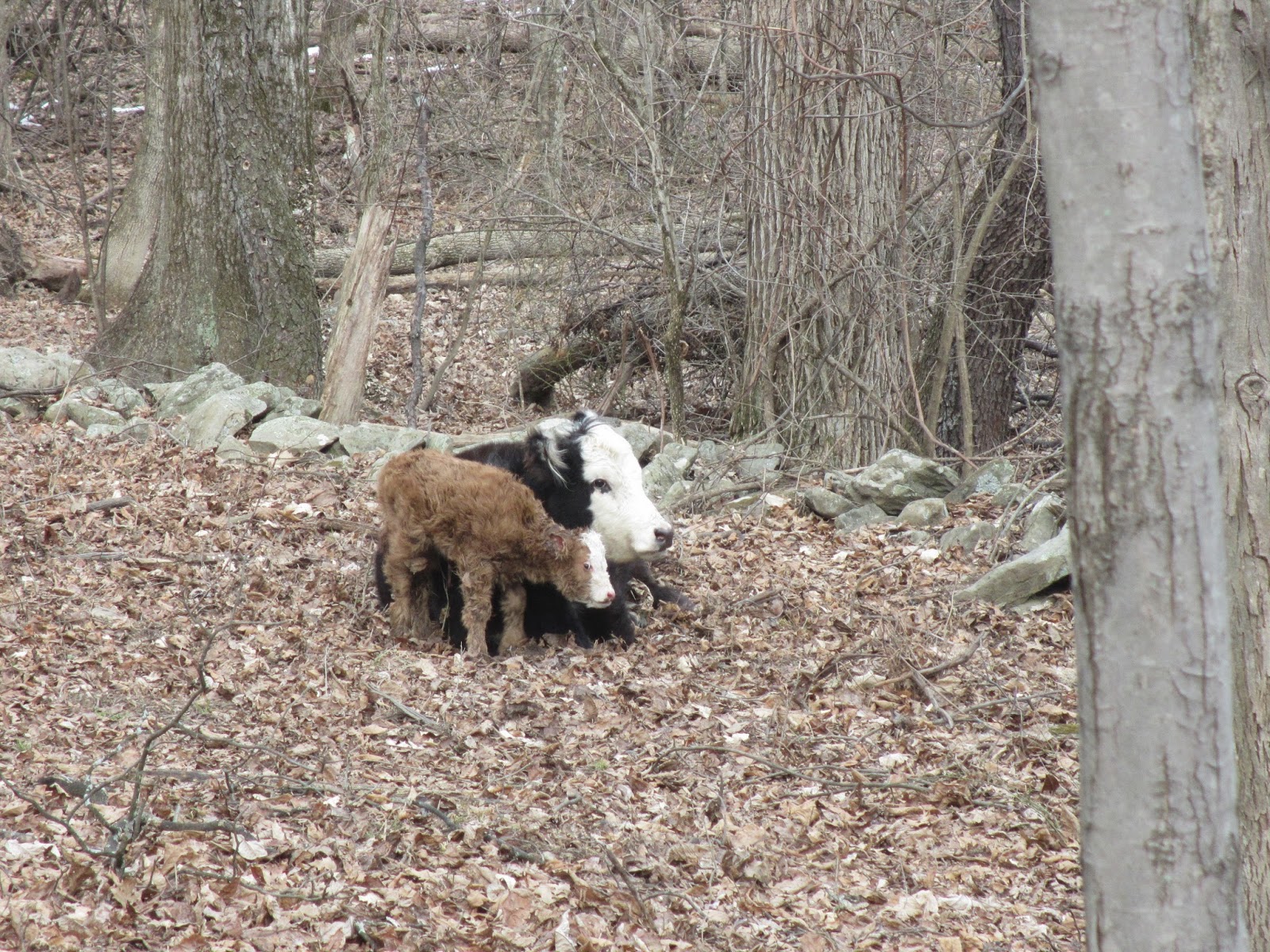
Summer's New Calf

Tuesday, March 11, 2014
Clementine at 10 Months
A comparison of our little bottle calf at a few days and 10 months old. She is now weaned and on forage, and fully integrated into the herd….but she hasn't forgotten her friends!


Friday, March 7, 2014
Updates Coming Soon!
We are hoping this winter ends soon-we will be coming out of hibernation soon and will have updates posted on pricing and availability. Only 2 1/2 weeks left until SPRING!
I'm posting a picture of Neel sharing some leftover corn and pumpkin with the herd from last fall-look at all that GREEN GRASS! This snow can't go away fast enough!

I'm posting a picture of Neel sharing some leftover corn and pumpkin with the herd from last fall-look at all that GREEN GRASS! This snow can't go away fast enough!
Thursday, August 22, 2013
Clementine

She was born on May 30th to a first time mother. The birth went well and she was a healthy little heifer, but when she got up and attempted to nurse, her mother would not allow her. This does sometimes happen with a first calf-it is always heartbreaking. After unsuccessful attempts to get one of the other cows to "adopt" her, we made the decision to bottle feed her. It is essential that calves get an adequate supply of colostrum (a nutrient and antibody rich substance that cows produce for only about 12 hours after delivering) in the first 2 hours after birth, and we were running out of time. We always TRY and keep a supply of powdered colostrum on hand, but on this day, it was a frantic race to the feed store to get more.
Clementine moved into our backyard where she would be safe from predators and/or other cows that normally her mother would have protected her from. She had a great appetite and quickly learned how to use the bottle. She spent her first 2 months camping out under our deck, where she had a fan to keep her cool and keep the bugs away, regular grooming, a straw house with an extra soft bed, and our three dogs as her playmates. She imprinted on Neel very quickly and would follow him around every morning and afternoon as we did the other chores. Regular calf stuff.
When we felt she was big enough to hold her own with the hard, we slowly re-integrated her. The other calves welcomed her immediately and Wallace the Bull was very protective of his little girl. She is living with them full time now and remains happy and healthy. She still gets bottled milk replacer 3 times daily but will be weaned in a few months along with the rest of the other calves.
Clementine will remain with us and become one of our breeding cows. Although I would always prefer that the animals are raised by their mothers in as natural an environment as possible, it has been a wonderful experience caring for her and getting to know her.
Monday, August 12, 2013
Pork is Ready!
There is still plenty of summer left-pick up some bacon and enjoy a great BLT with some ripe tomatoes, grill up some chops and sweet corn, or BBQ a roast for some great pulled pork. Check out the price list for availability and call or email an order!
Monday, June 3, 2013
A few of my favorite things.....


HFF Garden


We also added blueberry bushes and expanded the herb garden-now we just have to wait to harvest!


Monday, April 22, 2013


Wednesday, March 13, 2013
2013 Availability
We have been getting a number of emails lately of people looking to pre-order, and regarding current availability. Right now, we have GROUND BEEF at $5.90/lb and PORK CHOPS at $9.45/lb. EGGS are available throughout the season. CHICKEN will be processed this year June 15, 2013. We process 100 chickens at a time, as that is the number we can comfortably raise and process to our standards. At this time, we have about 35 left to pre-order. Please, get your orders in! Pork and beef will be available later this summer, we also recommend ordering early to ensure we have your favorite cuts!
Wallace in the Woods

Wednesday, November 28, 2012
Dangers of Supermarket Pork
http://health.yahoo.net/articles/nutrition/whats-pork
HFF pork is raised 100% antibiotic free! Plus, it tastes delicious!
HFF pork is raised 100% antibiotic free! Plus, it tastes delicious!
Wednesday, November 7, 2012
A great way to prepare your HFF chicken!
http://www.epicurious.com/articlesguides/bestof/toprecipes/bestchickenrecipes/recipes/food/views/My-Favorite-Simple-Roast-Chicken-231348

Read More http://www.epicurious.com/articlesguides/bestof/toprecipes/bestchickenrecipes/recipes/food/views/My-Favorite-Simple-Roast-Chicken-231348#ixzz2BY51BIPz
- One 2- to 3-pound farm-raised chicken
- Kosher salt and freshly ground black pepper
- 2 teaspoons minced thyme (optional)
- Unsalted butter
- Dijon mustard
preparation
Preheat the oven to 450°F. Rinse the chicken, then dry it very well with paper towels, inside and out. The less it steams, the drier the heat, the better.
Salt and pepper the cavity, then truss the bird. Trussing is not difficult, and if you roast chicken often, it's a good technique to feel comfortable with. When you truss a bird, the wings and legs stay close to the body; the ends of the drumsticks cover the top of the breast and keep it from drying out. Trussing helps the chicken to cook evenly, and it also makes for a more beautiful roasted bird.
Now, salt the chicken—I like to rain the salt over the bird so that it has a nice uniform coating that will result in a crisp, salty, flavorful skin (about 1 tablespoon). When it's cooked, you should still be able to make out the salt baked onto the crisp skin. Season to taste with pepper.
Place the chicken in a sauté pan or roasting pan and, when the oven is up to temperature, put the chicken in the oven. I leave it alone—I don't baste it, I don't add butter; you can if you wish, but I feel this creates steam, which I don't want. Roast it until it's done, 50 to 60 minutes. Remove it from the oven and add the thyme, if using, to the pan. Baste the chicken with the juices and thyme and let it rest for 15 minutes on a cutting board.
Remove the twine. Separate the middle wing joint and eat that immediately. Remove the legs and thighs. I like to take off the backbone and eat one of the oysters, the two succulent morsels of meat embedded here, and give the other to the person I'm cooking with. But I take the chicken butt for myself. I could never understand why my brothers always fought over that triangular tip—until one day I got the crispy, juicy fat myself. These are the cook's rewards. Cut the breast down the middle and serve it on the bone, with one wing joint still attached to each. The preparation is not meant to be superelegant. Slather the meat with fresh butter. Serve with mustard on the side and, if you wish, a simple green salad. You'll start using a knife and fork, but finish with your fingers, because it's so good.
Read More http://www.epicurious.com/articlesguides/bestof/toprecipes/bestchickenrecipes/recipes/food/views/My-Favorite-Simple-Roast-Chicken-231348#ixzz2BY51BIPz

Subscribe to:
Posts (Atom)